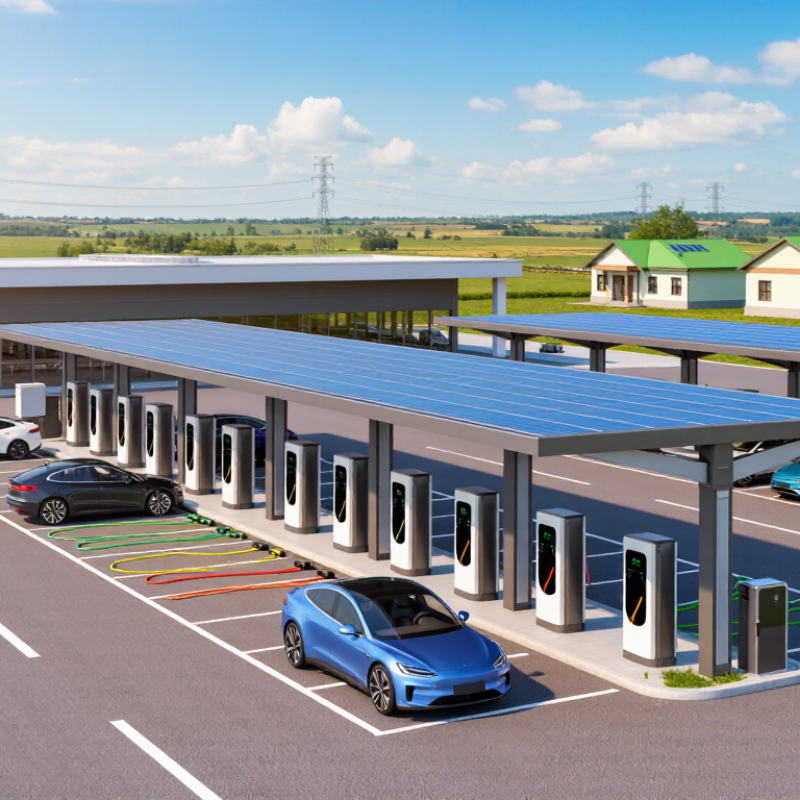
| Expansion of public charging networks |
AC destination charging and DC fast charging are deployed across homes, workplaces, retail areas, highways, and fleet depots. |
More corridor charging, urban curbside charging, and high-utilization fleet hubs. |
The global public charging stock exceeded 4 million points in 2023 and increased by more than 40% during that year. |
Requires faster permitting, standardized site design, upgraded distribution feeders, and better geographic coverage. |
| Higher-power DC fast charging |
Passenger-vehicle chargers commonly range from approximately 50 kW to 350 kW, depending on the vehicle and site. |
More 150–500 kW installations, with improved thermal management and charging curves. |
A compatible vehicle may add a substantial driving range in roughly 10–30 minutes under suitable conditions. |
High-power sites need medium-voltage connections, liquid-cooled cables, load balancing, and larger transformers. |
| Megawatt charging for heavy-duty transport |
Heavy commercial vehicles generally use high-power DC systems, often above 350 kW at dedicated depots. |
Megawatt-class charging is expected to support electric trucks, buses, and logistics fleets. |
Emerging systems target approximately 1 MW or more, subject to vehicle battery size, duty cycle, and grid capacity. |
Truck stops will require depot-scale energy planning, queue management, high-capacity substations, and on-site storage. |
| Smart charging and load management |
Charging schedules can be adjusted according to electricity prices, grid congestion, departure time, and battery state of charge. |
Managed charging will become common for residential, workplace, public, and commercial fleets. |
A coordinated charging session can shift demand away from system peaks without changing the required departure energy. |
Reduces simultaneous peak demand and may defer some grid upgrades when supported by suitable tariffs and controls. |
| Vehicle-to-home and vehicle-to-grid charging |
Bidirectional charging is technically available in selected vehicle, charger, and market configurations. |
More vehicles will provide backup power, renewable-energy shifting, and grid-balancing services. |
Typical residential bidirectional systems are designed around approximately 5–12 kW, while grid services may use aggregated fleets. |
Requires bidirectional hardware, interconnection rules, battery-warranty clarity, cybersecurity, and flexible electricity markets. |
| Integration with renewable energy and storage |
Charging sites increasingly combine grid electricity with solar generation, stationary batteries, and energy-management software. |
More charging hubs will use batteries to reduce grid peaks and absorb variable renewable generation. |
Stationary storage can reduce the instantaneous grid connection required for high-power charging, although results vary by site load profile. |
Encourages hybrid charging sites, peak-demand control, local energy management, and improved resilience during outages. |
| Plug-and-charge interoperability |
Digital authentication can use standardized communication between the vehicle and charger to reduce manual payment steps. |
Seamless authentication, roaming, automatic billing, and transparent charging data will become more widespread. |
Standards such as ISO 15118 support secure vehicle-to-charger communication and can enable automated authorization. |
Operators will need compatible software, reliable connectivity, data governance, and consistent user-account management. |
| Wireless and automated charging |
Stationary wireless systems commonly target approximately 3.7–22 kW for passenger vehicles; automated conductive systems are also developing. |
Greater use in taxis, autonomous fleets, accessible parking, buses, and high-frequency commercial operations. |
Wireless charging efficiency can approach the low-to-mid 90% range under suitable alignment and system conditions. |
Requires embedded or surface-mounted equipment, precise alignment, interoperability testing, and higher installation costs. |
| Reliability, uptime, and predictive maintenance |
Remote monitoring, payment diagnostics, temperature sensing, and fault notifications are increasingly used at charging sites. |
Charging networks will be managed more like critical digital infrastructure, with service-level and uptime reporting. |
Reliability depends on hardware, software, connectivity, weather, maintenance response, and local electrical conditions. |
Requires modular replacement, remote resets, spare-parts planning, standardized fault codes, and transparent uptime measurement. |
| Cybersecurity and data protection |
Charging infrastructure connects vehicles, payment systems, network platforms, buildings, and utility interfaces. |
Security-by-design, encrypted communication, access control, software updates, and incident monitoring will become standard requirements. |
The attack surface expands as charging points become remotely managed and connected to energy-management systems. |
Operators need secure device identity, segmented networks, patch management, privacy controls, and tested recovery procedures. |
| More accessible urban and residential charging |
Home charging remains important, but residents without private parking depend on workplace, curbside, shared, and public facilities. |
Cities will expand curbside charging, apartment charging, accessible parking spaces, and charging-as-a-service models. |
Residential AC charging typically operates around 3.7–22 kW, depending on the electrical connection and charger configuration. |
Needs equitable siting, parking enforcement, standardized payment, building-code updates, and protection for pedestrians and accessibility users. |
 VoltEdge Charging